 . . . .
World's Largest Selection of Wicks!
Wicks for virtually every heater, stove and lamp made since 1850
Early American Metal
Lamps and Lanterns
A trip these days to virtually any store in America
that sells lamps will generally uncover only cheap glass font lamps made
in China. These lamps are not for serious use and are actually
more like mood enhancers for special occasions than rugged lamps for
everyday use. From 1880 until about World War I, however, a great
number of very interesting metal lamps were made in the New England
states. Lamps with metal fonts were made for about any purpose one
could imagine, and made rugged enough to last for centuries. The
lamps below represent only a tiny fraction of the many styles of flat
wick lamps made during that period. These are flat wick lamps, not
circular wick lamps, which are shown here.
|
 |
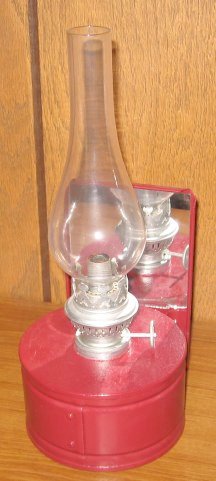
At left is a Plume and Atwood (P&A) Risdon
warehouse lamp. The industrial oil can like font is made
from quite thick metal. The reflector is permanently
attached with an "L" bracket. That beautiful finish is
nothing more than extremely well done galvanizing! This
lamp uses a #2 burner with a standard 3" diameter fitter.
Click on any photo to enlarge for more detail.
|
`
|
At right is a cute
little bedroom lamp for long winter nights. The
mirrored reflector is on a flat panel which is permanently
soldered to the back of the font. The font has seams
top and bottom, with the middle section being a flat wrap of
steel with a soldered and riveted seam in the front.
The burner on this lamp is a #6 Kosmos-Brenner, and the
chimney is a 1 1/4" fitter.
|
 |
|
 |
This lamp is a wall bracket style
designed to fit into a slotted steel wall holder, yet be
easy to remove and carry via the handle. These lamps
were quite popular for lighting the way from the porch to
the outhouse on long winter nights. The font has two
seams, top and bottom, and the metal is so thick as to be
almost bulletproof. A #2 Queen Anne burner is used.
When I bought this lamp on eBay it was supremely ugly, but
cleaned up quite well.
|
|
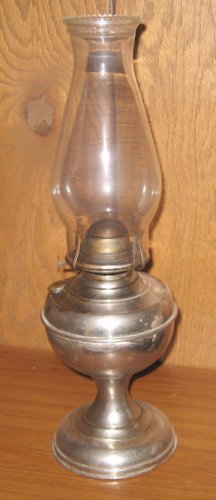
The lamp on the right represents the
normal cheap lamp available a century ago, made from steel
and with a nickel finish. A normal #2 burner was
fitted. Even though inexpensive, the lines are very
pleasing. This lamp was made by P&A Risdon.
|
 |
|
 |
The lamp at left is a P&A Risdon table
lamp in the process of restoration. It uses a #2
burner to which is permanently attached the shade ring.
These lamps were more costly, having a weighted base and
more intricate, classical configuration that could well have
pleased the ancient Greeks. This lamp had a special
inner font - a 2" x 5" galvanized steel
cylinder into which the burner was screwed.
|
|
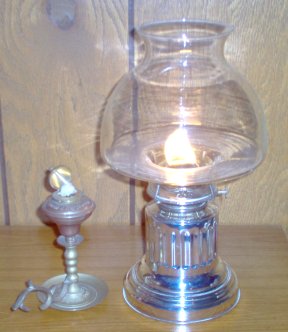
At right is a sterling silver P&A Risdon
table lamp with a weighted base. This lamp was also
built using the inner cylinder font system, as it allowed
almost any configuration of outer shell to be employed.
Note the unusual, original chimney. Beside it is a brass
whale oil lamp from the 1850's - no chimney, poor light output
and horrible smoking characteristics.
|
 |
|
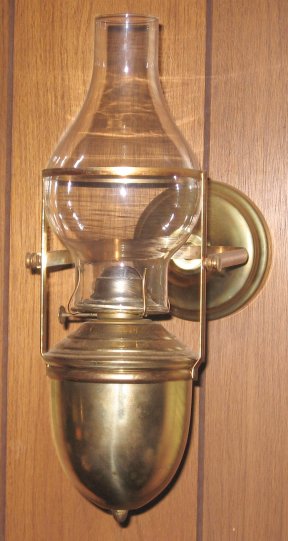 |
At left is a P&A Risdon restaurant wall
lamp. This lamp also used the inner cylinder font
system. Construction is brass plated steel for
durability, plus the gimbaled wall mount to compensate for
being knocked about. The unusual original chimney fit
perfectly within the upper ring and thus had an excellent
chance for survival. The disadvantage of the small
inner cylinder was a 3 or 4 hour burn time.
|
|
At right is a tiny brass "finger" night
light. This lamp used a 3/8" wide wick and produced
feeble light, but was sufficient to allow one to safely
navigate dark halls and stairways. The base of the
lamp was also a spill tray, a nice safety feature. Not
much light output, but very little fuel consumption.
|
 |
RAILROAD, MARINE, BICYCLE AND CARRIAGE
LANTERNS
|
 |
 |
 |
|
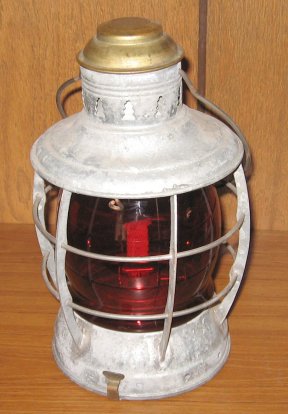
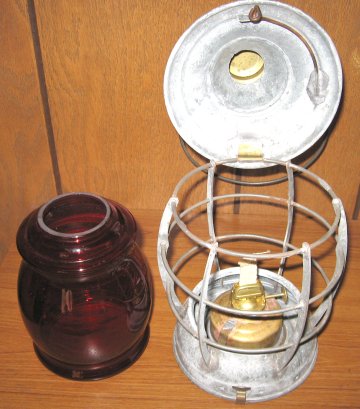
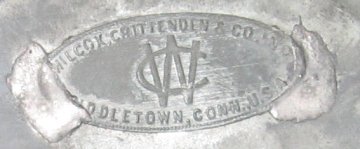
This
is a very rare Wilcox Crittenden lantern made under contract
for the US Navy in 1942. WC made marine hardware, not
railroad lamps, and they were not made for sale to the public.
This metal lamp, owned by a friend of mine, is absolutely
pristine, unused, in the original box. |
 |
|
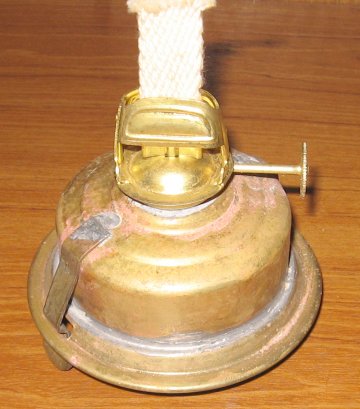
The body is steel with
extremely heavy galvanizing, and without the bottom protective
grillwork which is virtually a signature feature of railroad
lanterns. Railroad lamp buffs will notice the similarity
of the burner to those used on Adlake railroad lanterns, but
the winding stem is considerably shorter and the font itself
is of a different design and construction. The red globe
has a reduced top section, unlike Adlake and Dressel chimneys, and does
not have a focusing fresnel. |
|
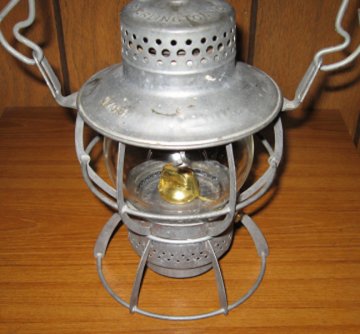
At right is a classic
Dressel railroad lantern. Note the traditional sturdy
protective grillwork, particularly at the bottom of the lamp,
and contrast this with the Wilcox Crittenden naval dock lamp
above. The lens is interchangeable with a red lens with
a focusing Fresnel.
This particular specimen is
unfired and in perfect condition. Stamped Dressel,
Arlington, NJ, for the N.Y.C.S. railroad. |
 |
|
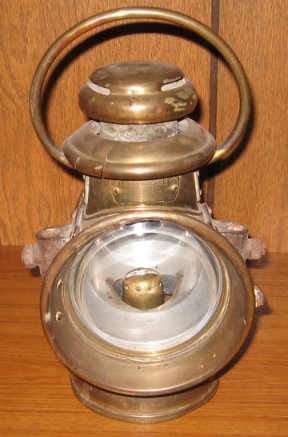
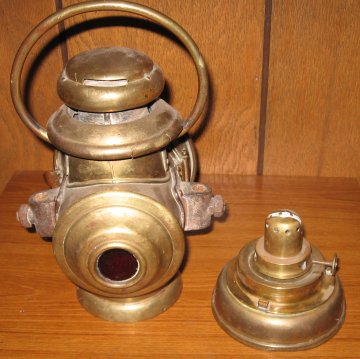
At right is a British
carriage lamp. Far right shows the red lens at the rear of the
lamp and the font and burner assembly. There are no side
jewels, as this particular lamp has brackets on both sides for
mounting on either side of a carriage. The name plate is
marked J & R Oldfield Ltd, Birmingham, England. Pat. #
843 / 1913. This is a large lamp, 12" tall, and the
clear lens is 4 1/2" diameter. |
 |
 |
|
 |
 |
 |
|
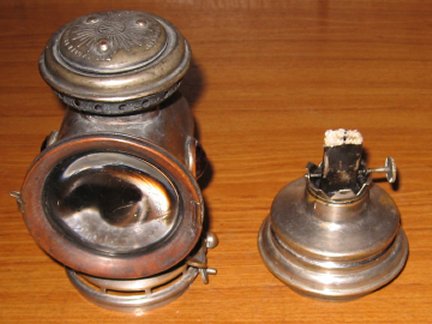
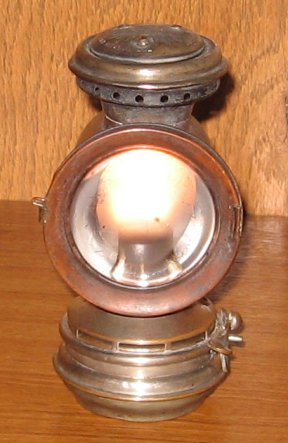
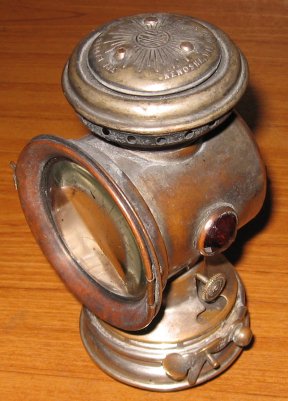
"Solar" bicycle lamp, made
by The Badger Brass Mfg Co, Kenosha, Wis. The jewel
lenses on either side are red, with no lens in the back.
The photo above left shows the font and burner removed.
The photo center shows the lamp in operation, with the
reflector working as intended. The photo above right
shows the ground red lens on the right side, below which is
the wick raising knob and font release clasp. |
|
 |
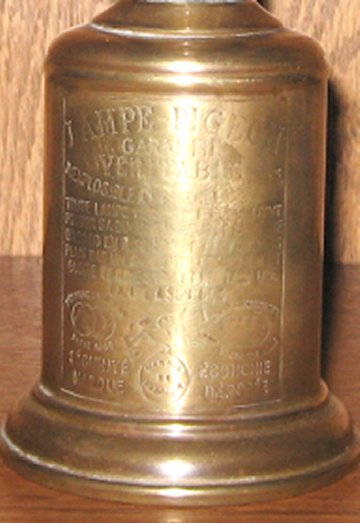 |
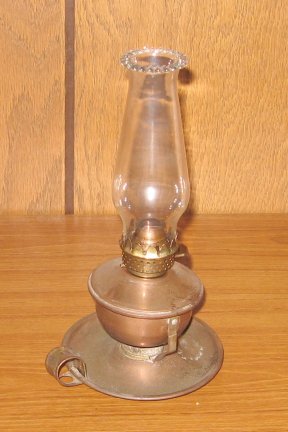
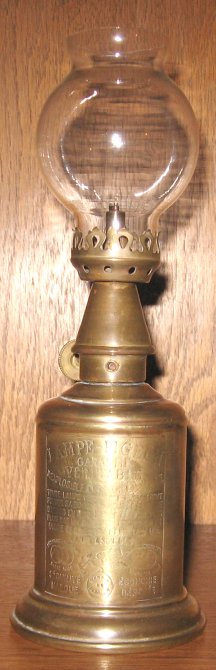
"Lampe Pigeon, Garinte,
Veritable, Inexplosible Essence Minerable, Paris, 1885,
Securite Maroue."
Generations of hands
have worn this copper lamp down, but it still works perfectly.
Low light output, perfect for a night light. The font is
filled with batting to prevent fuel sloshing when carried, but
kerosene precipitates paraffin. After a century of use,
paraffin had coated the batting to such an extent that fuel
could not be absorbed! I filled a 3 pound coffee can
with water, inserted the font, and boiled for an hour over a
Haller stove. The
paraffin dissolved, floated to the surface, and poured off
easily. Now it works! |
Back to top of page
|
Home Page Click Here
Wicks for kerosene space heaters,
click here.
Lamp Wicks:
Center Draft Wicks - Wicks
available only from this Wick Shop.
Flat lamp wicks
Aladdin Lamp Wicks
& parts
Lamp Chimneys:
Center Draft Lamp
chimneys
from "Tiny" Junior to Mammoth lamps.
Fabulous "Sans Rival"
borosilicate chimney for 14''' Kosmos lamps
Student Lamp Sans Rival Chimney with
1 7/8" fitter!!!
Standard glass lamp chimneys
Sonnenbrenner Lamp Chimneys
Information on lamps:
Center Draft Kerosene Lamps
(Photos, information and history, etc)
Photos of
restored center draft lamps
Care, Feeding and Restoration of Center Draft
Lamps
(and wick
installation for many)
Center Draft
Lamp manufacturers and brand names
Lamp Chimneys
- Dimension of
nominal base diameter by make, model and "line".
Early American Metal Font & Specialty Lamps
Aladdin Lamp History
Aladdin Lamp Wicks & Chimneys,
Aladdin - Exploded burner views
Kosmos-Brenner lamps
and wicks
Flame Spreaders and
"Smoke
Consumers"
from Alex
Marrack
-
Vulcan, Imperial, Veritas,
Belgian, Hinks, Messenger's, Young's Court, etc.
Articles by Alex Marrack:
Home Page
Site Index
Site Index for all things Perfection
Kindler Wicking For Oil Stoves & Ranges
Kerosene Heaters
Alphabetical list of most kerosene heaters and the proper wick,
& cart checkout.
List by wick number and the heaters that fit them. (A
helpful guide for buying on eBay)
Back to top of page
|