An "flame spike"
can be caused by too high a wick in a multi-wick stove as
well as an air leak. To determine the problem, grab
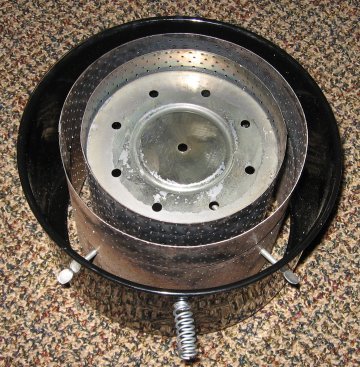
the wire handle (see photo above) on the catalytic
converter and move it slowly from side to side while
watching the flame. If the flame spike does not
move, the cause is a wick too high. Remember
the location (10:30, 3:00 o'clock, whatever), cool the
stove, remove the catalytic converter, and trim down the
offending wick.
If the flame
spike moves with the catalytic converter, the cause
of the flame spike is an air leak. That is easy to
fix. Place a new sheet of sandpaper of 120 to 150
grit on a flat surface, like a Formica countertop.
Place the catalytic converter base down on the sandpaper
close to you and hold an edge of the sandpaper down
against the countertop. Then gently stroke the
catalytic converter away from you, one stroke!, while
keeping the catalytic converter as flat as
possible. Lift the catalytic converter and return
it to the near edge, then make another stroke. Now
you can examine the bottom edge of each cylinder.
The shiny spots were high spots that were sanded
down. The dull places are too low and will cause an
air leak. Repeat the sanding strokes until both
cylinders are shiny rings all the way around.
Bingo, no air leak.
That whole
operation takes less than 10 minutes, and your kerosene
stove will now burn properly. Now the wicks can be
raised higher, producing more heat without a flame spike
causing sooting on your pots and pans.
STORAGE
Be sure to store
the stove "dry," empty of fuel, to avoid any condensation
in the fuel tank. After the fuel is emptied from
the tank, light the wicks, assemble the stove, and let it
burn for a half hour or so until all fuel is out of the
wicks - the flame will go down demonstrably. Lower the
wicks while peeking under the catalytic converter so that
just a little flame is showing (perhaps 1/8" or so of
wick exposed), then re-seat the catalytic
converter. The wicks are cotton so they will burn
when dry. As the last of the fuel is burnt from the
wicks, the wicks themselves will burn, which will burn
off any carbon deposits. The wicks will burn down
to the top of the wick tubes - and they will be nice and
even in height, perfect for the next use of the
stove.
At this point, the
stove should be taken apart and given a nice coat of
polish. Normal liquid auto polish should be applied
to all surfaces, inside and out. All it takes in
about 15 minutes, and the pores of the enamel are filled,
the stove will not rust in storage, nor will spilled food
cause any stains.
The catalytic
converter should be examined. If dirty or sooty,
the guide rods should be removed and the cylinders washed
in hot, soapy water until clean. If not too bad, a
thin brush can be employed to brush off the
cylinders. If the stove is to be stored
indoors in a dry place, nothing else need be done to the
catalytic converter. If, however, the stove is to
be stored in a garage or anyplace with a high humidity,
the cylinders need to be oiled to prevent
rusting.
Finally, store the
stove in a tight fitting box, and seal the box. The
next time you need the stove it will be absolutely ready
to use. Just fill with fuel, wait a half hour for
the wicks to suck up fuel, and light it.