|
WICKS TO FIT THE HEATERS LISTED
BELOW - AND MORE!
Unique Specialty wicks
for
19th Century lamps
|
 . . . .
World's Largest Selection of Wicks!
Wicks for virtually every heater, stove and lamp made since 1850
"Sad Iron" Stoves
from the 19th Century
Haller
and Beatrice Stoves
Jump
to REPLACING A SAD IRON
WICK
From the early
1880's through the 1890's, Myers Osborn & Co of
Cleveland, Ohio (as well as many regional foundries) made
some very useful little cast iron stoves. These
stoves were made in one wick, two wick and three wick
models. All had a large mica window in the front,
so they provided light as well as heat. All of the
models had a sturdy cast iron handle in the back so they
could be easily carried.
The utility of sad
iron stoves was limited only by the imagination of the
user. They could boil water, heat a sad iron,
or be used as a carriage heater - while providing some
light.
One unique feature
of sad iron stoves was the unusual wick - wide and long,
usually 3 5/8" to 4" wide and 8" long. These wicks
have not been available in North America in over 60
years, but that dearth is now over! Hattersley in
England has made dense weave 3 5/8" and 4" wide sad iron
wicks especially for me, and they are available now on my
Lamp Wick page or below. See photographs
below.
|
|
|
|
|
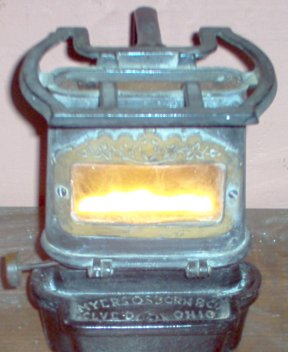
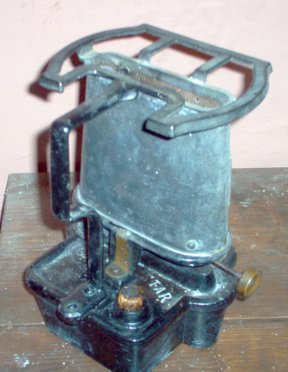
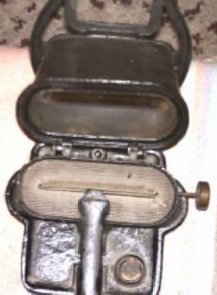
Photographs
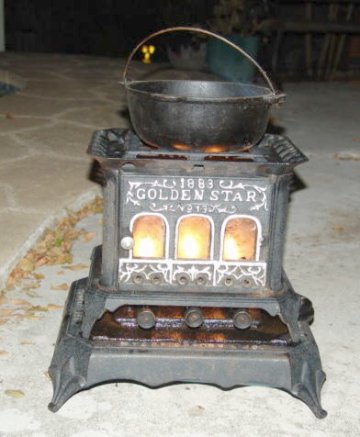
of my Golden Star single wick stove. The
photo on the left shows the large mica window in
the front providing some useful light. The
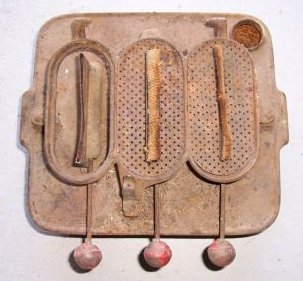
center photo above shows the back of the stove and
the carry handle; note the original cork fuel
cap. The photo on the right has the cast iron
chimney folded forward, exposing the wick carrier
assembly. Click on the photos to enlarge.
Wicks are available on my lamp wick
page. Mica for window replacement is available
here.
|
|
|
 |
The photo at left
shows a three wick Golden Star stove in
operation. The Texas
owner of this stove is happy to have it working
again. The photo in the middle shows a 3 wick
Golden Star in sad shape, needing restoration - and
wicks. Click on photos to enlarge them.
|
As you can see from
the size and thickness of the wicks and the small area of
chimney, these stoves would smoke and smell something
fierce if kerosene is used as a fuel. They were
designed to burn the more volatile kerosene available prior to 1918,
which was similar to what is now "Low Odor Mineral Spirits," the same as
B & H and P &
A center draft lamps.
EUROPEAN MINI KEROSENE
HEATER/STOVES
Beatrice -
Haller
|
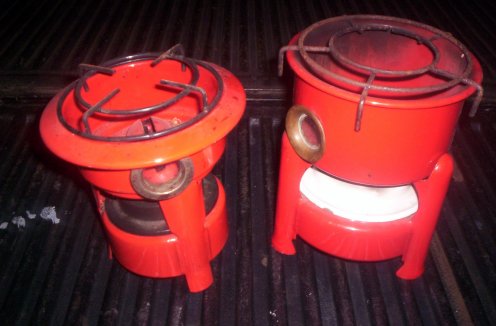
In
England, the Beatrice Foundry greatly improved on
the "sad iron" concept with extremely useful
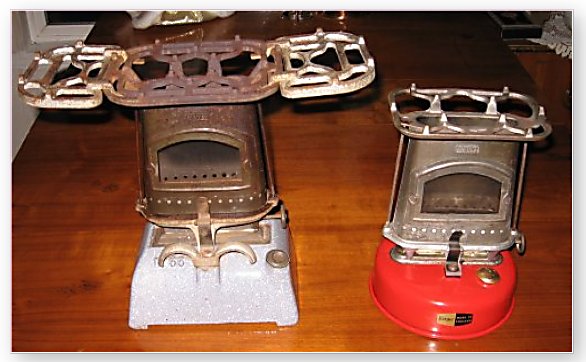
"boiling stoves." On the left is a beautiful
1901 Beatrice #33 Boiling Stove, with an enameled
cast iron base and extremely rare top extensions
for larger pots and pans: Refinishing is not yet
complete. The more modern (post war?) Harper
Beatrice Boiling Stove has a steel fuel tank and is
considerably small and lighter. Both use a 4" flat
wick,
available on my flat wick page.
Mica for window replacement is
available
here.
|
 |
|
|
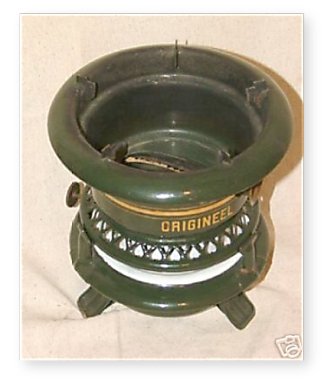
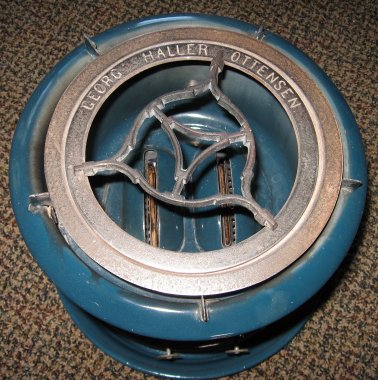
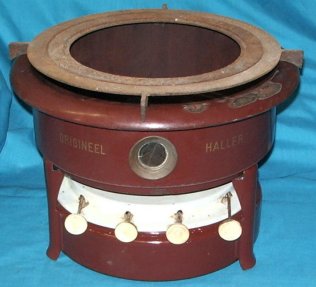
At left is a Haller "Origineel" stove
made by Georg Haller Co of Ottensen (Hamburg),
Germany. Haller stoves date from circa 1900, but
some
variations (clones) were made in the former
East Germany and are marked DRG. It is of
enameled steel construction. The white area
visible at the bottom of the stove is the wick
holder, and the venting visible allows a
considerable amount of fresh oxygen to feed into
the 2 9/16" flat wick. This stove burns very
clean and odor-free. The fuel reservoir is
primitive, however, being nothing more than a basin
for the wick, and care must be taken to prevent
spilling.
Haller stoves were designed
to use
a thin
2 3/4" Kosmos flat wick.
|
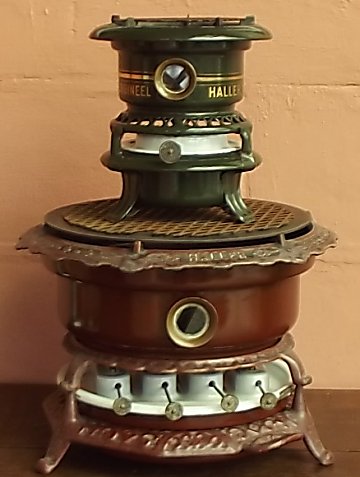
Larger Haller Stoves from my collection
|
 |
 |
 |
|
Haller 2-wick stove |
Haller 4 wick stove |
Haller 4-wick with 1-wick on top
for size comparison |
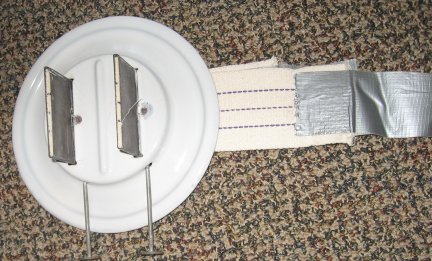
Replacing a Haller wick
|
A thin wick extension is made from
duct tape, then the duct tape fed down through the wick slots
through the gearing. The wick is then pulled down. This method
avoids any undue force on the gearing used to raise and lower the
wick. |
 |
REPLACING A SAD IRON
WICK
|
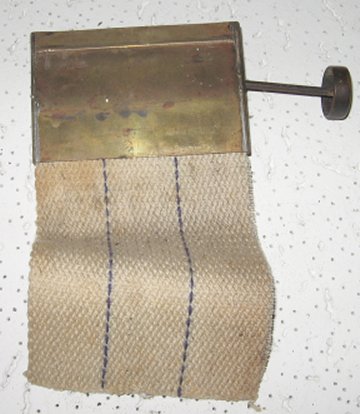
Most sad irons use a wick assembly similar to the
one at right. This simply lifts out of
the cast iron base. It is not known if P&A made most of the
burners used by individual manufacturers but they are all
similar. |

This patent was granted to Lewis J.
Atwood and assigned to The Plume & Atwood Manufacturing Company.
Credit for this photo goes to
The Lamp
Works. |
|
|
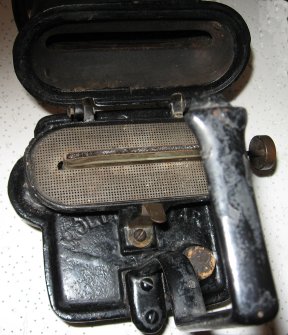
Tip the chimney over to expose
the wick. Some sad iron heaters have two or
three wicks, but the principle is the same.
In the spring latch which holds the chimney shut
there is usually a screw. First remove the
debris screen very carefully with a slim, flat
bladed knife, then remove the screw in the spring
latch. Click on the photos to enlarge
them.
|
|
|
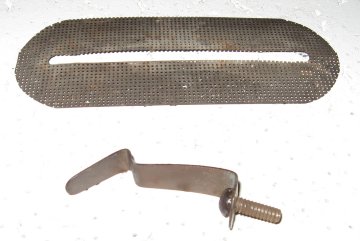
The debris screen, spring latch
and screw removed. Many hardware stores sell stiff brass mesh
material which can be cut with sturdy scissors to replace a
missing debris screen. |
|

|
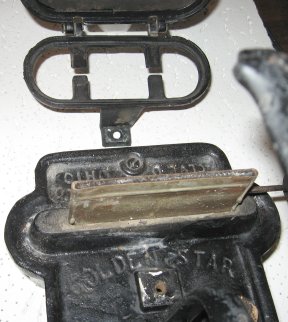
The sad iron stove
with the debris screen and spring latch removed,
exposing the wick raising assembly.
NOTE: Many sad iron stoves have missing
fill caps. The fill cap hole is often not threaded and therefore a
cork is usually used to close the fill hole when burning the
stove. |
|
|
Very carefully lift up the
chimney and cast iron base for the chimney holder
and expose the wick raising assembly. The
wick and wick raising assembly can be pulled
straight up and removed from the sad iron
base.
Once completely disassembled,
the sad iron stove can be refinished and repairs as
necessary - without painting any of the parts
together which makes future disassembly very
difficult.
|
 |
Now a new wick can be properly
installed from the bottom side. Cut off all
fuzzies on the new wick and trim the top corners
with a slight bevel to ease installation. Be
sure to carefully polish the brass wick holder to
prevent corrosion, as it may not need to be
disassembled for another half-century!
Reassemble the sad iron stove in
the reverse order as listed above.
|
|
How do I trim the wicks on the sad
iron? Question from Mark
You don't "trim" the wick in the
normal sense of the word because it is flat out
impossible to "trim" an almost 4" wide wick
perfectly level. So, you install the wick as evenly
as you can, then raise it 1/8" above the top of the
wick tube. Trim off obvious high spots, then lower
the wick 1/8" into the wick slot. Saturate the TOP
of the wick with an eyedropper or two of kerosene
or mineral spirits. Raise the wick so the lowest
portion of the wick is 1/16" or so above the wick
tube. Light the wick, put on the chimney, and let
the wick burn down level. At that point you can
raise the wick 1/4", trim down the ends at a 30
degree angle for perhaps 1/4" maximum, then lower
to 1/16" or so exposed. Fill the fount with fuel,
wait a half hour, then light. You should have a
nice even burn across the entire top of the
wick.
|
|
SAD IRON
WICKS
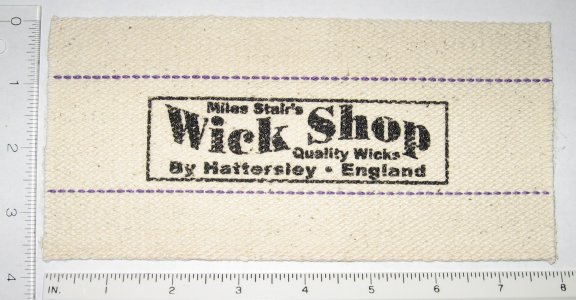
3 5/8"
wide, 8" long or 24'' long. Perfect for sad irons
requiring 3 5/8 to 3 7/8" wide wicks.
Click here for the wicks.
|
|
|
SAD IRON
WICKS
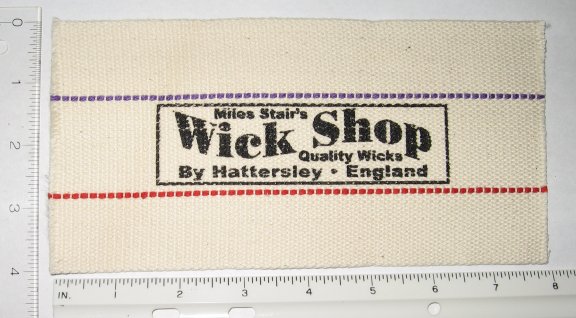
4" wide, 8" long or 24'' long. Ideal for
sad iron stoves requiring 4" wicks and European stoves
like the Beatrice Boiling Stove.
Click here for the wicks.
|
|
Back to top of page
|
Home Page Click Here
Wicks for kerosene space heaters,
click here.
Lamp Wicks:
Center Draft Wicks - Wicks
available only from this Wick Shop.
Flat lamp wicks
Aladdin Lamp Wicks
& parts
Lamp Chimneys:
Center Draft Lamp
chimneys
from "Tiny" Junior to Mammoth lamps.
Fabulous "Sans Rival"
borosilicate chimney for 14''' Kosmos lamps
Student Lamp Sans Rival Chimney with
1 7/8" fitter!!!
Standard glass lamp chimneys
Sonnenbrenner Lamp Chimneys
Information on lamps:
Center Draft Kerosene Lamps
(Photos, information and history, etc)
Photos of
restored center draft lamps
Care, Feeding and Restoration of Center Draft
Lamps
(and wick
installation for many)
Center Draft
Lamp manufacturers and brand names
Lamp Chimneys
- Dimension of
nominal base diameter by make, model and "line".
Early American Metal Font & Specialty Lamps
Aladdin Lamp History
Aladdin Lamp Wicks & Chimneys,
Aladdin - Exploded burner views
Kosmos-Brenner lamps
and wicks
Flame Spreaders and
"Smoke
Consumers"
from Alex
Marrack
-
Vulcan, Imperial, Veritas,
Belgian, Hinks, Messenger's, Young's Court, etc.
Articles by Alex Marrack:
Home Page
Site Index
Site Index for all things Perfection
Kindler Wicking For Oil Stoves & Ranges
Kerosene Heaters
Alphabetical list of most kerosene heaters and the proper wick,
& cart checkout.
List by wick number and the heaters that fit them. (A
helpful guide for buying on eBay)
Measurements needed if you have an unlisted heater.
Care and Maintenance of Kerosene Heater Wicks
Installing Kerosene Heater Wicks - generic for unpinned
wicks
Owner's_Manuals & information for many kerosene heaters
Kerosene
Heaters - General types, how they work, recommendations
for some good ones - and those I would avoid.
Economic Benefits of
Kerosene Heaters
Kerosene
Heater Safety
Regular
maintenance
Troubleshooting kerosene heater common problems
Breaking
In New Kerosene Appliances
Burning
Kerosene Heaters at Night
WATER IN KEROSENE causing "dwindling" and poor
performance.
Flame Spreader Heaters
and Lamps -
A Century of Excellence
Kerosene Heater Carts
-
why carry your heater around?
Kerosene Fuel Primer
Sweet
Smelling Kerosene
Kerosene tank cradles
(photo)
Building a Cradle
HALLER "ORIGINEEL"
STOVES
KEROSENE
HEATERS MADE IN THE NETHERLANDS
Beatrice Boiling Stoves & Mini kerosene heaters
you can make
Sad Iron stoves; Wicks &
Installation instructions
Wicking For Oil
Burning "WICKLESS" Stoves & Ranges
Photo Album
Photos of
Wicks
Mail Order
Form
Kerosene Stoves, Lanterns and Ovens
Kerosene Stoves -
Recommendations on different models
Kerosene
Stove Maintenance and Storage
Butterfly A-822, 22 wick, all-aluminum
premium stove.
Butterfly #2487, 16 wick stove.
Butterfly #2412 Pressure
Stove;
instructions for virtually any pressure stove.
Butterfly #2418
Double Burner Stove;
good with any gravity flow stove.
Butterfly #2421
Oven for Kerosene Stoves
Butterfly #2641, 10 Wick Stove
-
the least expensive emergency stove.
Butterfly #2698 Cook Stove -
THE Best Heavy Duty Cook Stove.
Butterfly
#828R Pressure Lantern;
same for most pressure lanterns.
Back to top of page
|